

Clients don’t separate your design, development, and hosting, they see one website and one accountable partner. When hosting fails, agencies take the blame whether they control it or not. Treat hosting as a core part of client management: define ownership clearly, standardize infrastructure, and bundle hosting and maintenance into retainers. Done right, hosting protects your reputation, reduces emergencies, strengthens client relationships, and creates predictable recurring revenue instead of unpaid, reactive work.
Agency client management isn’t just about Slack messages, status updates, and quarterly reviews. It’s about infrastructure accountability. There’s a reality many agencies eventually encounter: when hosting fails, you take the blame regardless of who’s actually responsible.
Smart agencies understand that client management starts with a technical foundation. It’s about defining clear ownership, building accountability into your service model, and treating hosting as a strategic asset rather than a commodity. In this guide, we’ll show you how hosting intersects with every aspect of client management: and how to use it to strengthen relationships, create recurring revenue, and protect your reputation.
The Hidden Truth: Hosting Is Client Management
What Clients Assume vs. What Agencies Actually Control
Here’s the core problem: clients assume everything is part of the scope. When you deliver a website, they believe you’re responsible for hosting, security, uptime, plugins, DNS, site health, and every technical detail in between. If you don’t explicitly define these boundaries upfront, they become your responsibility by default.
This isn’t a misunderstanding, it’s a natural expectation. Your client sees a functioning website. They don’t distinguish between your design work, your development, and the server infrastructure beneath it. It’s all “the website” to them, and you’re “the website people.”
Consider this common scenario: A client’s site goes down on Friday afternoon. They don’t know (or care) whether it’s a server issue, a plugin conflict, a DNS problem, or a security breach. They know one thing: their website doesn’t work, and you built it. Within minutes, you’re expected to diagnose, coordinate, and resolve. This is true even if the actual issue is completely outside your control.
This is why hosting isn’t separate from client management. It’s central to it.
How Hosting Touches Every Client Deliverable
The impact of hosting infrastructure ripples through every department of your agency:
For Marketing Agencies: Hosting directly affects SEO performance through Core Web Vitals, site speed, and indexing reliability. Your landing pages might be beautifully designed, but if they load slowly, conversion rates drop. Your PPC campaigns might be perfectly targeted, but if the site goes down during peak traffic, you’re burning budget. Analytics accuracy depends on consistent uptime. Every campaign’s success is tied to the performance of the underlying infrastructure.
For Development Agencies: Your deployment processes, version control workflows, and staging environments all depend on hosting quality. Debugging becomes exponentially harder on unstable infrastructure. Framework compatibility issues multiply when you’re working with underpowered shared hosting. A bad host creates slow development cycles, failed deployments, and inconsistent environments that make your team look incompetent.
For Creative Agencies: How your designs actually render, how assets load, how media is handled—all of this depends on hosting infrastructure. You can craft pixel-perfect designs, but if the site loads poorly, clients blame the design or UX, not the server. Launch deadlines get missed because of hosting provider delays. Your beautiful work gets undermined by technical limitations you didn’t choose.
The bottom line: if the hosting environment fails, your work looks broken, even if you didn’t cause it.
How to Talk to Clients About Hosting
Many agencies struggle to explain hosting value to clients without sounding overly technical. You can use the copy below verbatim in proposals, SOWs, or onboarding documents.
Client-facing proposal script:
Your website isn’t just design and content: it’s a living system that needs to be fast, secure, and available at all times.
We include managed hosting and ongoing maintenance to ensure your site loads quickly, stays online during traffic spikes, and is protected against security threats. This means fewer disruptions, better performance for your visitors, and faster resolution when issues arise.
Instead of relying on entry-level hosting or fragmented vendors, we use a performance-optimized hosting environment with proactive monitoring and real human support. This allows us to take full accountability for your site’s reliability and performance, so you’re never stuck coordinating between multiple providers when something goes wrong.
This framing keeps the conversation focused on outcomes, not infrastructure details.
What Your Client Gets With Managed Hosting
When hosting is positioned correctly, clients understand it as protection for their business.
What your client gets:
Faster page load times that improve user experience, SEO rankings, and conversion rates
Reliable uptime, even during high-traffic campaigns or seasonal spikes
Ongoing security monitoring and proactive updates to reduce breach risk
Automated backups with the ability to restore quickly if something breaks
Real human support when issues arise, not ticket queues or scripted responses
A single point of accountability for website performance and availability
What this prevents:
Lost leads during outages
Wasted ad spend due to slow or unavailable pages
Emergency rebuilds after failed updates or hacks
Confusion over who is responsible when problems occur
This clarity helps clients see hosting as essential infrastructure, not optional add-ons.
Establish Clear Ownership: The Website Stack Responsibility Matrix
The single most effective tool for managing client expectations around hosting is a clear responsibility matrix. This simple framework prevents dozens of headaches by establishing who owns what before problems arise.
Here’s what agencies need to define:
Use this matrix in your client onboarding process. Walk through each layer explicitly. Document the decisions in your contract and statement of work. When something inevitably breaks, you’ll have clear documentation of who’s responsible for what.
This isn’t about avoiding responsibility, it’s about establishing accountability upfront so everyone knows what to expect when issues arise. Explicitly putting hosting responsibilities into contracts is one of the most effective ways to prevent scope creep and client disputes down the line.
Retainer Models: Package Hosting as Recurring Revenue
Here’s a pattern we see repeatedly in agency forums and communities: agencies that don’t formally include hosting-related services in their retainers end up doing them anyway: reactively, urgently, and without compensation.
Most agencies are already doing this work. Sites are being monitored. Emergency calls about downtime are coming in. Critical security patches get applied as soon as vulnerabilities surface. The real question isn’t whether this work happens, it’s whether it’s being paid for.
What to Include in Hosting + Maintenance Retainers
A well-structured retainer should include:
Monitoring and Uptime Management
Sites go down. Someone needs to watch them. Whether it’s your monitoring tools or your hosting provider’s, someone needs to be accountable for catching issues before clients do and for responding immediately when they arise.
Updates and Maintenance
WordPress core, plugins, themes, security patches: these need regular attention. Leaving them to clients is a recipe for disaster. Most clients will ignore updates until something breaks, then expect you to fix it for free.
Performance Optimization
Site speed affects everything: SEO rankings, user experience, conversion rates, campaign effectiveness. Regular performance audits and optimization should be part of your ongoing service, not a surprise project that comes up when the client complains about slow load times.
Security Hardening and Incident Response
Beyond basic patches, this includes firewall configuration, malware scanning, intrusion detection, and having a response plan when something goes wrong. Security incidents will happen. Clients need to know you have a process.
Bug Fixes and Small Enhancements
Minor fixes, content updates, small functionality changes: these ongoing requests are inevitable. Building them into a retainer creates predictable revenue and keeps clients from feeling nickel-and-dimed.
Hosting as a Revenue Stream, Not a Cost
As one agency founder shared on Reddit’s web hosting community: “My agency is a full-service digital agency and only takes clients that also take our web hosting and maintenance packages. … The revenue from hosting and maintenance is something we can count on month after month.”
This sentiment is echoed across agency forums and communities. Industry analyses from agency management platforms like Bonsai and developer communities like RadDevon consistently emphasize that positioning hosting and maintenance as a value-add creates stronger, more profitable agency-client relationships.
This approach isn’t about being opportunistic. It’s about aligning incentives properly. When you control hosting and maintenance, you can:
Deliver fixes faster (no waiting on third-party support)
Standardize your technical stack (reducing complexity across clients)
Protect your reputation (by ensuring infrastructure quality)
Create predictable, recurring revenue (that’s valued at higher multiples than project work)
There are three common models agencies use:
Option 1: Reseller Model
You mark up hosting and provide direct support. This gives you maximum control and revenue potential, but requires either ops expertise in-house or a reliable infrastructure partner who can handle the backend while you manage the client relationship. Many hosting providers offer specialized agency hosting solutions designed specifically for this model.
Option 2: Preferred Provider Referral
You standardize on a reliable hosting partner and strongly recommend (or require) that clients use them. You don’t mark up the hosting, but you benefit from simplified support and consistent environments. This works well for agencies without technical operations capacity.
Option 3: Managed Hosting + Maintenance Bundle
You package hosting, maintenance, monitoring, and support into a single monthly service. This creates the stickiest client relationships and provides maximum control over the entire technical stack. It’s the most comprehensive approach but requires the most operational capability.
Each model works. The key is choosing one intentionally rather than letting hosting responsibility happen by accident.
How to Keep Control When the Client Owns Billing
One of the biggest fears agencies have with referral-based hosting is losing control of the client relationship. That risk is real, but it’s avoidable with the right structure.
The most effective model is control without ownership.
In this approach:
The client owns the hosting account and billing for transparency
The agency retains technical access, management rights, and visibility
Hosting accounts are linked back to the agency for administration and support coordination
This allows you to remain the technical authority while giving clients confidence that they are not locked into a black box.
With proper account-linking tools and permissions, agencies can manage environments, troubleshoot issues, and work directly with hosting support without becoming the billing middleman.
Safeguards That Protect the Agency–Client Relationship
Agencies that successfully refer hosting without losing clients rely on a few non-negotiable safeguards:
The agency remains the primary technical contact
Hosting support can communicate directly with the agency when issues arise
Clear escalation paths are documented and shared
Access controls ensure the agency can manage updates, performance, and security
Clients understand that hosting is part of the agency’s delivery ecosystem
These guardrails prevent “vendor drift” and ensure the agency stays positioned as the strategic partner, not just the builder.
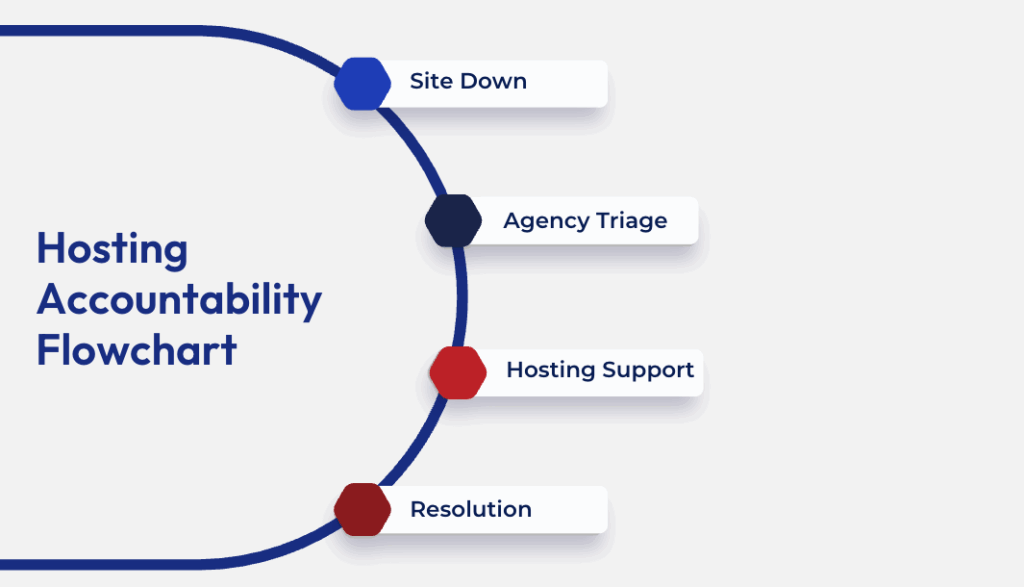
The Single Point of Accountability Framework
When something goes wrong, clients don’t want a triangle of blame between their agency, their hosting provider, their DNS registrar, and their IT department. They want one person who takes ownership.
Great client management means being able to say: “If something breaks, here is who you contact, how quickly we’ll respond, and what we’ll do to resolve it.”
This requires agencies to simplify the technical stakeholder map. Every additional vendor in the mix creates potential for finger-pointing and delayed resolution. This is why many successful agencies either take full control of hosting or establish very clear, documented escalation paths with their hosting partners.
Why Agencies Should Control (or Strongly Influence) Hosting Decisions
If you let clients pick their own hosting provider, you inherit all of its weaknesses. We see this repeatedly:
Entry-level shared hosting causing slow load times and frequent downtime
No staging environments, forcing you to test changes in production
No automatic backups, creating risk on every update
No built-in security features, requiring you to add layers of protection
Underpowered infrastructure that can’t handle modern site requirements
Support that takes days to respond (while your client is calling you hourly)
When you control or strongly influence hosting decisions, you can:
Choose platforms optimized for your tech stack and workflows
Get faster support, which means you deliver faster fixes to clients
Enforce standards for performance, security, and reliability
Avoid the “mystery IT guy” complications (the client’s nephew who “knows computers” and insists on managing DNS)
Protect your reputation by ensuring quality infrastructure
This perspective is widely shared across developer communities. On web development forums, experienced agency owners consistently argue: “I always host for clients… clients should have their own hosting services [only if] you have a strong background working as a Linux system admin.” The message is clear: if you lack deep infrastructure expertise, don’t leave hosting to chance.
Best Practices for Integrating Hosting Into Client Management
Set Expectations in Contracts
Contractual clarity around hosting is one of the most common pieces of advice in agency communities. Define hosting responsibilities explicitly in your agreements:
Who owns the hosting account and infrastructure?
What are the uptime guarantees and SLA terms?
How frequently are backups performed and where are they stored?
Who is responsible for security patches and how quickly are they applied?
What is the support response time for critical issues?
What happens if the client wants to move to a different hosting provider?
This documentation becomes essential when disputes arise. This pattern appears so frequently in agency discussions that it’s become a core principle of professional client management: define technical boundaries before problems arise, not during them.
Standardize on Reliable Infrastructure
Don’t reinvent server operations with every new client. Successful agencies standardize on one or two hosting platforms that they know inside and out. This approach:
Reduces complexity across your client portfolio
Lets your team develop deep expertise with specific platforms
Simplifies monitoring and maintenance workflows
Makes it easier to transfer knowledge as your team grows
Creates leverage when negotiating with hosting providers
For agencies managing primarily WordPress sites, managed WordPress hosting with built-in performance optimization, security hardening, and automatic updates can eliminate entire categories of client management headaches.
Treat Hosting + Maintenance as Core Deliverables
Hosting and maintenance aren’t one-off setup tasks. They’re ongoing deliverables that clients expect even when they’re not explicitly spelled out. The most successful agencies bake this into their service model from day one.
This means:
Including hosting and maintenance in your standard proposals
Pricing it as a clear line item or bundled monthly service
Communicating the value (uptime, security, performance, peace of mind)
Making it easy for clients to say yes by positioning it as standard practice
When you treat hosting as optional or separate from your core services, you undermine its importance. Clients perceive it as an upsell rather than a necessity. Frame it as part of what professional agencies do, because it is.
Match Your Model to Your Capabilities
If you don’t have strong ops or sysadmin experience on your team, don’t try to become a hosting provider overnight. Partner with a reliable managed hosting provider who can handle infrastructure while you focus on client relationships and creative/strategic work.
The key distinction that emerges from these discussions is recognizing hosting as a “fundamentally different discipline” from design or development. Infrastructure management requires expertise in security, server configuration, uptime monitoring, and performance optimization. If those aren’t your core competencies, acknowledging that limitation and partnering accordingly is a sign of professional maturity, not weakness.
However, if you do have technical operations capability (or are willing to build it), taking fuller control of hosting can create significant competitive advantage and revenue opportunity.
What to Look for in a Hosting Partner
If you’re working with an external hosting provider, certain criteria are non-negotiable for agencies managing multiple client sites:
Real Human Support, 24/7
Not chatbots. Not offshore call centers reading scripts. Experienced professionals who understand the platforms and can solve problems when they arise, including at 2 AM when a client site goes down during a product launch.
Multi-Site Management Capabilities
Agency-specific dashboards, the ability to manage dozens or hundreds of sites from a single interface, consolidated billing, and efficient provisioning for new clients.
Performance-First Infrastructure
NVMe storage, built-in caching, CDN integration, and modern server architecture. Performance should be standard, not an upsell. Your clients’ SEO rankings and conversion rates depend on it. Understanding how hosting affects website performance can help you evaluate whether a provider’s infrastructure will truly support your clients’ business goals.
Strong Uptime Guarantees
99.9%+ uptime backed by an actual SLA. Not marketing language, real guarantees with compensation if they fail to deliver.
Scalability Without Complexity
The ability to start small and scale up (shared to VPS to dedicated) without migrating providers or completely rebuilding infrastructure. Your clients will grow. Your hosting should grow with them. VPS hosting offers a middle ground between shared hosting and dedicated servers, providing dedicated resources without the complexity of full server management.
Agency-Friendly Features
Staging environments, easy migrations, white-label options (if you’re reselling), Git integration, and WP-CLI access for developers who need it.
The right hosting partner becomes an extension of your team. The wrong one becomes a constant source of client management headaches.
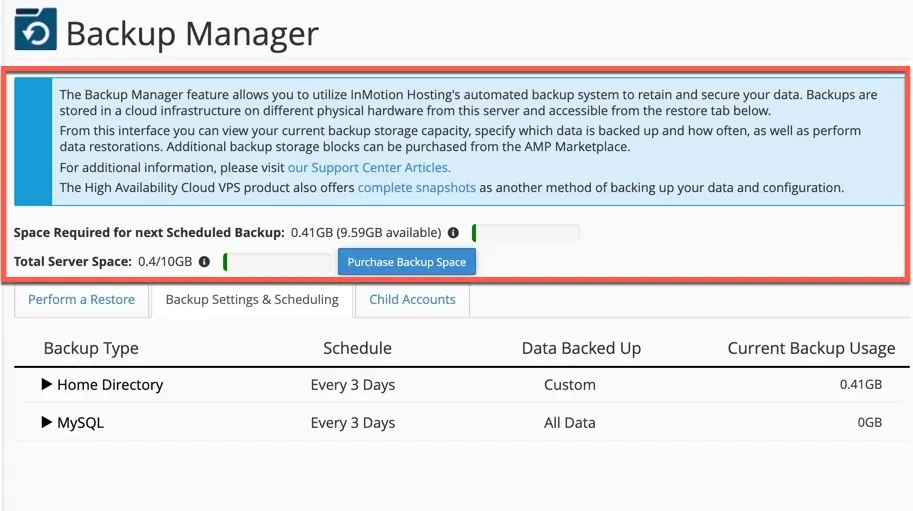
Backups and Restores: The Feature Clients Understand Instantly
Backups are one of the easiest features for clients to understand, and one of the most important for agencies to evaluate.
Not all backups are created equal. What matters isn’t just that backups exist, but how usable they are when something goes wrong.
Agencies should look for:
Frequent, automated backups (not manual or weekly-only)
Clear retention periods, not rolling overwrites
Offsite storage to protect against server-level failures
Fast, reliable restore processes: ideally one-click or support-assisted
Defined expectations around restore timelines
Strong backup and restore capabilities act as insurance for your work. They turn worst-case scenarios into recoverable incidents instead of reputation-damaging disasters.
When Poor Hosting Becomes a Business Risk
Poor hosting doesn’t just cause technical issues, it creates real business consequences that affect client relationships, team resources, and revenue. Here’s what agencies face when infrastructure isn’t reliable:
When Campaign Performance Meets Infrastructure Limits
You launch a major Black Friday campaign for an e-commerce client. Traffic surges, conversions start climbing…then the site goes down. Their hosting can’t handle the load.
The impact: $50,000 in paused ad spend, an emergency migration under pressure, and a client questioning your strategic planning, even though you had no control over their hosting decision.
When Security Gaps Create Liability
You deliver a polished website for a healthcare client. Three months later, outdated server software leads to a security incident. Client data may be compromised.
The impact: Your work comes under scrutiny despite having no hosting access or oversight. Years of relationship building are at risk because infrastructure wasn’t treated as a strategic asset.
When Support Becomes Unsustainable
You build custom WordPress sites but let clients manage their own hosting. Soon you’re spending 8+ hours monthly per client troubleshooting issues you can’t control, and can’t bill for.
The impact: Nearly $40,000 in annual lost revenue for a 10-client roster. That’s enough to add a full-time team member or significantly improve margins.
The Strategic Question
These scenarios happen at agencies every day. The question isn’t whether hosting issues will cost you, it’s whether you’ll take control of the infrastructure that supports your work before they do.
When hosting is treated as a strategic decision, not a commodity, these problems become preventable. That’s why agencies trust partners who deliver performance-first infrastructure, real human support, and accountability when it matters most.
The Bottom Line: Infrastructure Is Client Management
The agencies that thrive long-term understand a fundamental truth: infrastructure is client management.
Consistent results require a reliable technical foundation. Reputation rises or falls with uptime and performance. Recurring hosting and maintenance contracts create a healthier, more predictable revenue model. And client relationships are stronger when accountability is owned outright, not passed off to external vendors.
This doesn’t mean every agency needs to become a hosting company. It means every agency needs a clear, intentional strategy for how hosting fits into their service model and client management framework.
The agencies we see succeeding are the ones who:
Define hosting responsibilities clearly from the start
Package hosting and maintenance into retainers
Standardize on reliable infrastructure partners
Take ownership of accountability (even when problems originate elsewhere)
Treat hosting as strategic asset rather than commodity
By taking control of the technical foundation, you protect your reputation, create recurring revenue, and deliver better outcomes for clients. That’s not just a good hosting strategy, it’s good business.
The data supports this approach. Agencies that bundle hosting and maintenance into their service offerings report:
Higher client retention rates
Increases in average client lifetime value
Significantly fewer emergency support requests
Stronger positioning as strategic partners rather than order-takers
Most importantly, they report better sleep at night: knowing that when a client calls with a problem, they have the access, authority, and infrastructure quality to actually solve it.